Is conversation the next 3D modelling tool? We tested AI modelling in Rhino
Driving geometry by talking in Rhino, then rendering the loop in Fenestra, and what AI 3D modelling can and can't do yet.

Shaun McCallum
June 16, 2026Every jump in how we model in 3D has really been a jump in interface.
The drawing board gave way to CAD, and a mouse replaced a pencil. CAD gave way to parametric tools like Grasshopper, and we started defining geometry with logic instead of lines. Each time, the thing that changed wasn't the building. It was the gap between having an idea and getting it onto the screen.
So here's a fair question about the current wave of AI. Most of it generates images, and done well that's enormously useful, it's the heart of what Fenestra does. But a smaller strand is exploring something different. You describe a form in plain language and an agent builds it for you in Rhino. You talk, and the geometry moves. People call it agentic 3D modelling, or text-to-3D, and the idea of a real AI for Rhino 3D has been circling for a while. Is it the next interface, or just a party trick?
The short version: conversation isn't going to replace Rhino for serious modelling, yet. But as the layer that connects concept, model and render, it's already useful. That's a capability worth understanding properly, the kind of thing we pay attention to at Fenestra, so we spent a week testing the idea end to end.
What we tried
We wired Rhino up to a conversational AI, drove geometry by talking to it, then pushed the result into Fenestra to render. We used an open project to make the connection. It's early, proof-of-concept stuff, and it isn't the point here.
What matters is how it feels. Today it mostly handles primitives, boxes, spheres, curves, plus whatever geometry you can script. It won't model a façade detail or hand you a clean .3dm of your scheme yet.
But even there, something clicks. You stop reaching for tools and start describing intent. “Put a double-height void on the north side. Pull the roof up three metres and cantilever it towards the water.” You're not drawing, you're directing. When it's wrong, which is often, you say so and it tries again. If you've ever wished for a real AI inside Rhino, this is the honest version of that promise: exciting, rough, and clearly pointed somewhere.
If you'd like to try it yourself, check out this great opensource RhinoMCP project on GitHub.
https://github.com/jingcheng-chen/rhinomcp
The more interesting half
The model was never the point. The loop was.
We exported the Rhino geometry into Fenestra for AI rendering for architecture, and ran it in both directions.
We started with a concept image from Fenestra, a quick read on what the space wanted to be, and used it to brief the modelling so the AI had something to aim at. From there it was fast. Model in Rhino, render in Fenestra, see what the image surfaced, adjust the geometry, render again. Fenestra turned each version into a photoreal frame in seconds, so the only thing we were really iterating was the design. When it looked right, that was the final.
Concept briefed the model, the model fed the render, the render sent us back to the model with something useful to say. Three stages that normally live in three apps, talking in one loop. It's the same loop behind conversational AI architectural rendering, with the modelling step pulled in alongside it.
So, is conversation the next 3D modelling tool?
The honest answer is no and yes. The geometry isn't there, the control isn't there, and for anything precise you'll be faster by hand for a long time yet.
But that might be the wrong question.
What conversation is good at isn't beating Rhino at its own job. It's moving between jobs. It briefs the model from a concept. It carries a render's feedback back into the geometry. It connects the parts of the process that have always been islands, where you rebuild the same idea three times and lose something each time.
Seen that way, conversation isn't the next modelling tool. It's the layer that lets your modelling tools talk to each other. That's a bigger deal than a better box command.
That's the kind of capability we're exploring. Rendering is the part that already works, the dependable step in the loop, whether you're taking a Rhino model to a photorealistic render, turning a CAD drawing into a 3D visualization, or moving from sketch to render. What interests us now is the connective tissue around it, making the handoffs between concept, model and render quietly disappear.
Because that part doesn't move. The agent has no view on whether the proportion is right or the light feels honest. It can shift the geometry, but it can't tell you when to stop. You still bring the eye. The point was never to make more AI slop. It's to make something only you can, with less dead time between the idea and seeing it properly.
More soon.
Bring your Rhino Projects to life
Create NowRelated Articles
Fenestra 101: Sketch to Render, Virtual Staging and AI Editing for Architects & Interior Designers
In this introductory Fenestra webinar, we walk through the core tools architects and designers can use to turn early ideas into visual concepts. The session covers sketch to render workflows, virtual staging, adding furniture, editing images, removing elements and using AI to quickly explore design directions.
Fenestra 101: Our First Webinar
We're running our first ever live webinar on June 3rd. A hands-on intro to Fenestra for architects and interior designers, covering image generation from prompts, 2D and 3D inputs, video, and where AI actually fits in your practice. 30 seats only.
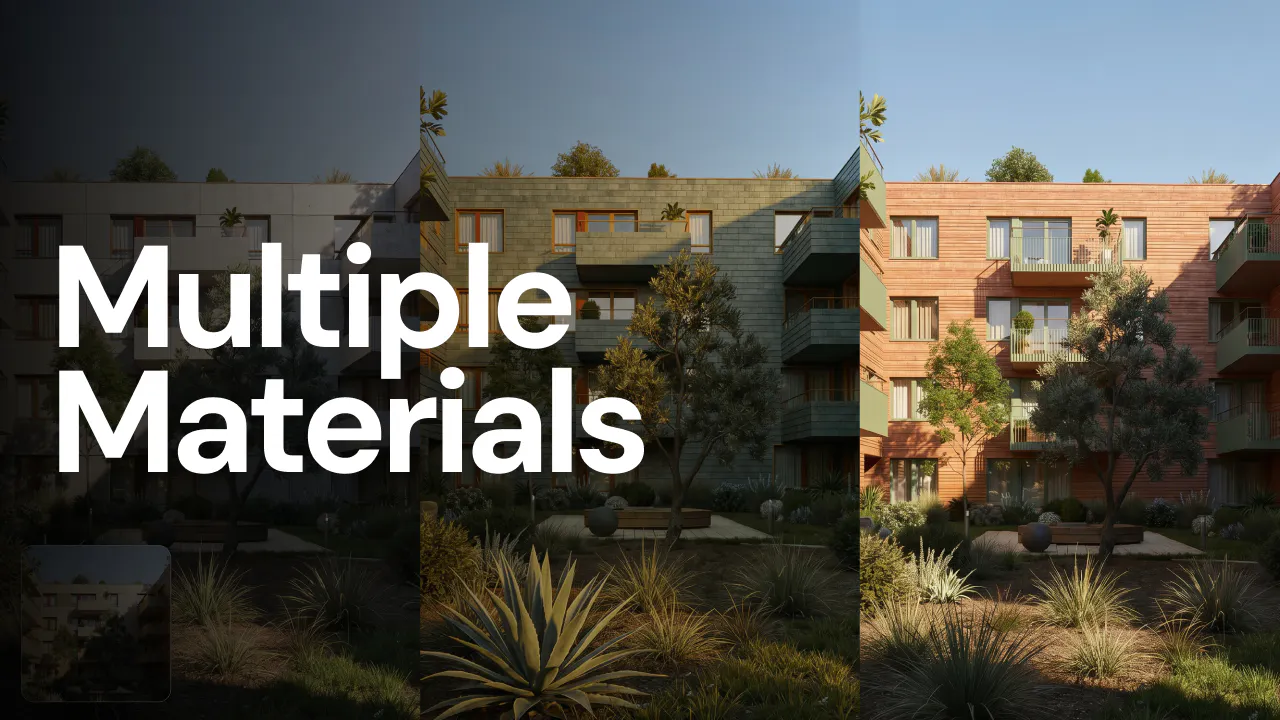
One image, three directions
Most studios don't need one perfect render. They need a decision. Here's the three-direction workflow that turns one image into three plausible futures, and a faster way to land design choices that win client meetings.
